
Learning log 01
Designing for unfamiliar domains
How being new to APIs led me to build a user research practice for developer tools at Postman.
TL;DR
I didn’t know enough
→ so I used product analytics to find experienced users
but I couldn’t understand every technical detail
→ so I partnered with engineers during research
But we didn't just want the conversation to end with a feature list
→ so we observed real workflows and built with users
we tested and iterated for ~30 days
→ took the evidence back to product leadership
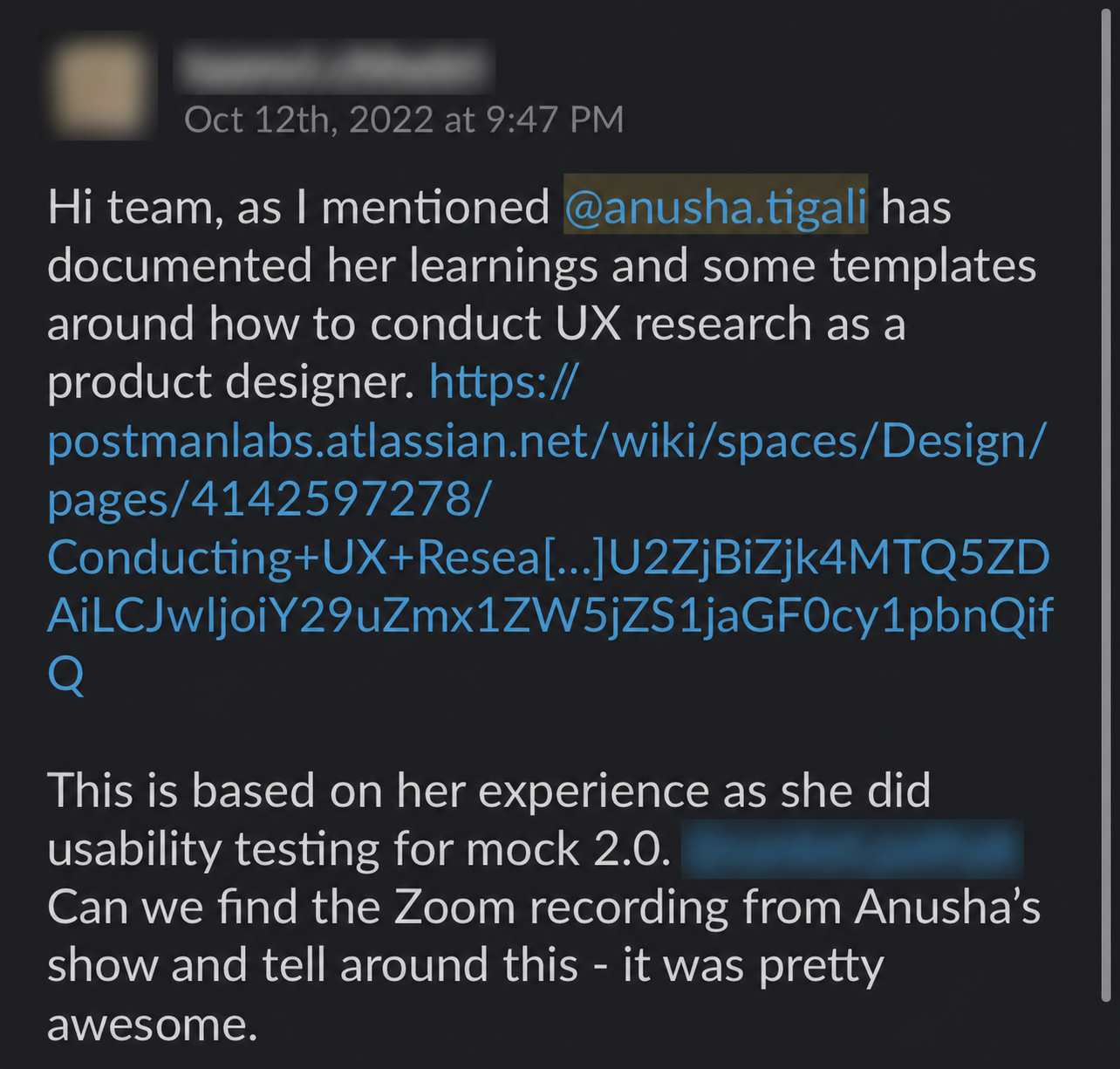
→ and turned what worked into a research playbook for other designers.
That's the neat version.
The interesting parts are everything that happened between those arrows: how we used six months of usage data to find the right developers, why engineers became part of my research process, what changed when users became collaborators instead of interview participants, the research session that didn't go according to plan, and how one product study eventually became a reusable research practice.
Designing a developer tool I didn't yet understand
When I joined Postman, I was moving from an agency into a product company. I was also moving into a technical domain that was completely unfamiliar to me: APIs.
One of the first developer tools I was responsible for was Postman Mock Servers.
The simplest way to understand a mock server is as a stand-in for a real server. When teams are building APIs, the client and server may not be ready at the same time. Developers still need a way to build and test how the two will eventually communicate, so a mock server gives them something predictable to work with before the real server exists.
I understood how this worked in theory.
What I didn't understand was how developers were actually using it.
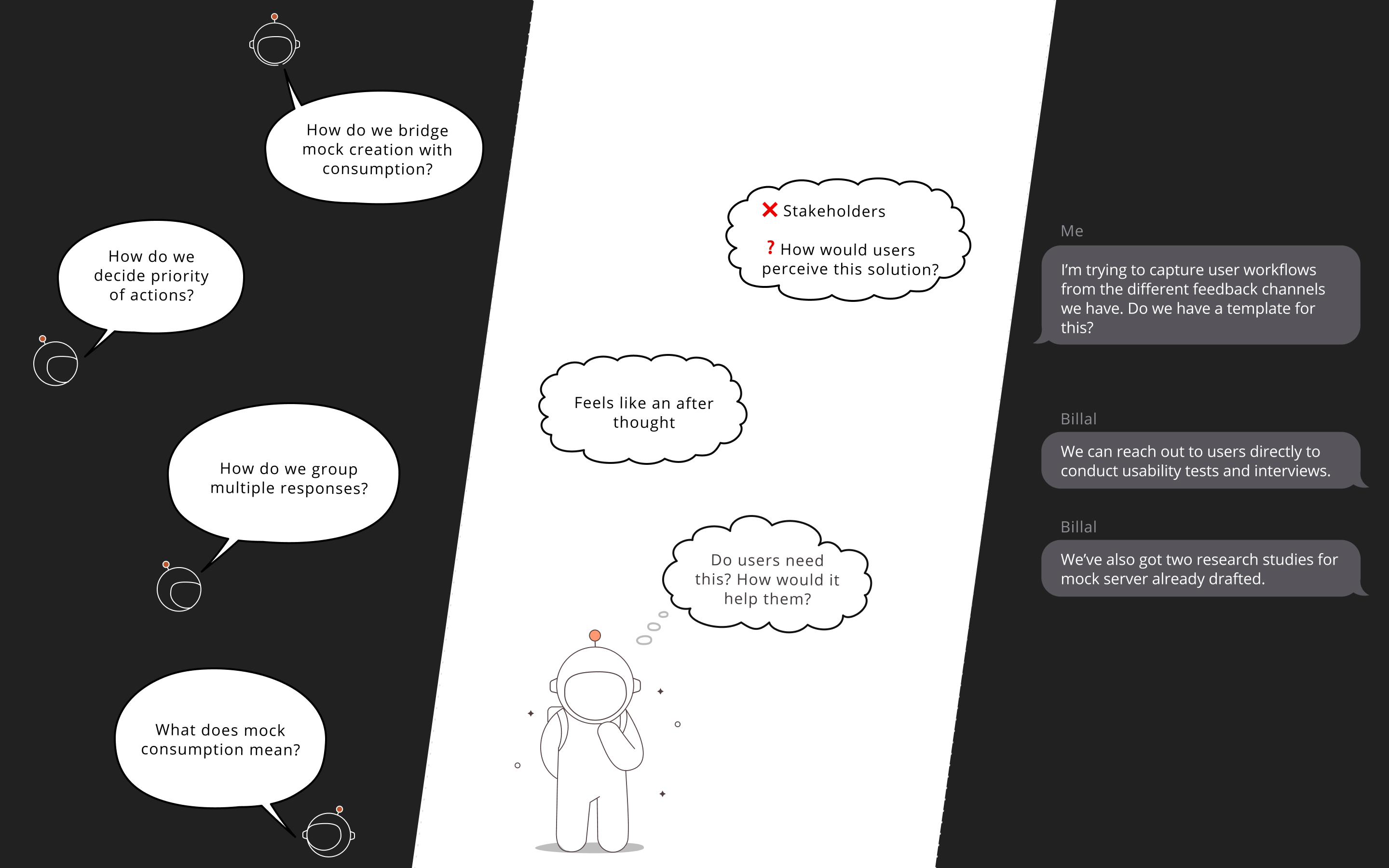
That mattered because the PM who had previously owned Mock Servers was leaving when I joined the team. There wasn't a clear product roadmap waiting for us. There was me, a product designer still learning APIs, and a team of engineers who understood the technology far better than I did.
I was fortunate to work closely with an engineer, Aman Dhembla (opens in a new tab), who helped me understand the fundamentals of APIs, Mock Servers and the underlying technology. As a team, we could generate plenty of ideas for what the product could do next.
So I learnt how Mock Servers were meant to be used. I didn't know whether that matched how developers actually used them, where they struggled, what they'd worked around, or where Mock Servers fit into their broader API development workflow.
Before making product decisions, I needed to understand that.
Using product analytics to find the right users
The first question was which developers.
Someone who had created one mock server once wouldn't necessarily tell us much about how the product fit into a real development workflow. Fortunately, usage analytics had already been set up for Mock Servers.
Aman Dhembla (opens in a new tab) and I reviewed roughly six months of usage data to identify developers who used Mock Servers regularly.
We deliberately looked beyond one-time creation. We wanted sustained behaviour: developers who had created mock servers, returned to use them, and potentially created more.
These were people for whom Mock Servers appeared to be an actual part of their work.
Research recruitment brought another set of practical questions. We had to understand company policies, decide how to compensate participants for their time, and find incentives that made sense for Postman's developer community. We eventually offered Amazon gift vouchers alongside Postman swag.
We contacted around 100 users, about ten responded.
The analytics had helped us identify who to speak to. The research could now help us understand why they behaved the way they did.
But getting those developers into a conversation exposed the next gap.
Many of them knew far more about APIs than I did.
Pairing design research with engineering expertise
Being new to APIs meant accepting the limits of my technical knowledge.
The developers we interviewed could surface deeply technical questions I wasn't equipped to answer. Pretending otherwise wouldn't make the research better.
So I stopped treating user research as something the designer needed to conduct alone.
I began partnering with an engineer during research sessions.
The engineer could explore technical details, understand implementation questions and troubleshoot problems as they emerged. That allowed me to concentrate on a different layer of the developer experience.
Where did someone hesitate? What did they ignore? What had they learned to work around? Where did their mental model differ from ours?
The partnership worked because neither of us needed to play the other's role. Engineering brought technical depth. I focused on user behaviour, workflows and experience.
I didn't need to be the API expert in the room. I needed to make sure the right expertise was represented in it.
That solved the knowledge gap in the conversation.
But there was another limitation I wanted to avoid: asking developers to describe their workflows instead of actually seeing them.
Moving from user interviews to collaborative prototyping
I didn't want the research to become a series of interviews where developers told us what features they wanted and we went away with a list.
We wanted to see the work itself. So we structured the research in two parts.
First, developers walked us through how they currently used Mock Servers. This gave us direct observation of their workflows and allowed us to compare what we saw with patterns in our product analytics.
Then the relationship changed.
Instead of only interviewing users, we started building with them.
We created our own mock servers and API collections. We brought product concepts into sessions and let participants work through newer versions of the experience with us.
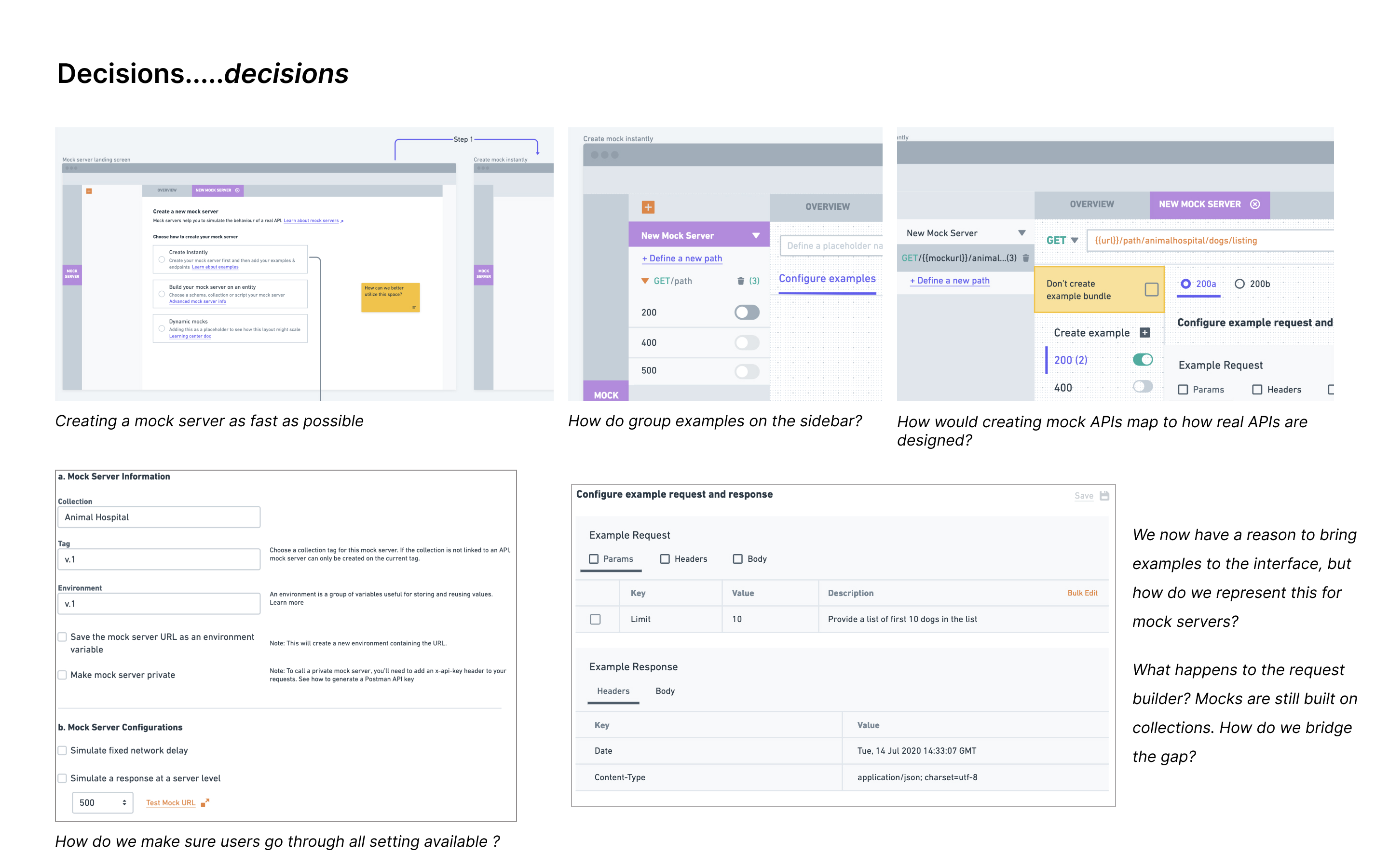
Instead of waiting until a redesign was finished to discover whether our assumptions were wrong, we could test ideas while they were still changing.
Observe → Build → Test → Learn → Iterate → Repeat
We worked this way for roughly 30 days.
The product direction gradually became something that had evolved alongside the developers using Mock Servers rather than something the team had brainstormed internally.
That changed the conversation when we eventually took the work to product leadership.
We weren't simply saying, here's what we think we should build.
We could show what we'd observed, what we'd tried, what hadn't worked, what we'd changed, and why we believed the product direction made sense.
Research had become part of product decision-making rather than a validation step at the end.
But once you let real users into the process this closely, research doesn't always follow the plan.
Things don't always go according to plan
One participant really didn't want to talk about the things I'd planned to discuss. He was frustrated with other parts of Postman. And for almost 45 minutes, he told us about them. Most of those problems weren't something I owned. But he was a customer. He paid for the product, used it regularly and had finally been given a direct line to someone from the company.
So I listened.
I couldn't promise that everything would be fixed, particularly when much of it belonged to other product teams. But I could make sure he felt heard and take the feedback back to the right people.
Even though things didn't go according to plan, I learnt something very important—and often tricky to solve for enterprises…
Users experience the product as a whole—not just the part your team owns.
They don't experience one feature as my team's product and another as someone else's product. They experience Postman. Sometimes useful research means allowing a conversation to go somewhere you hadn't planned, because that's where the user's actual experience is. After a month of working this way, we'd learned a lot about Mock Servers. But I'd also learned something about how designers could conduct research in a highly technical product without needing to work alone or already be the domain expert. That felt useful beyond one project.
Turning one product study into a reusable research practice
At the time, Postman no longer had the dedicated research team it previously had.
There was research knowledge within the organisation, but two challenges kept coming up:
- Designers didn't necessarily have a clear, repeatable process for conducting user research independently.
- A lot of designers also felt the same way I did: they were designers, not developers, so they didn't feel confident taking charge of these sessions with users.
The Mock Servers project had forced me to work through many of those questions myself.
How do you identify meaningful users using behavioural data? How do you recruit and compensate research participants? When should an engineer join a research session? How do you observe real developer workflows rather than rely only on self-reported behaviour? How do you involve users while product ideas are still evolving? And how do you turn research findings into product decisions?
By this point, we'd developed an approach that worked for us.
So I documented it.
I brought together the research structure, recruitment approach, templates, ways of partnering with engineers, iterative testing cycles and lessons from the Mock Servers study.
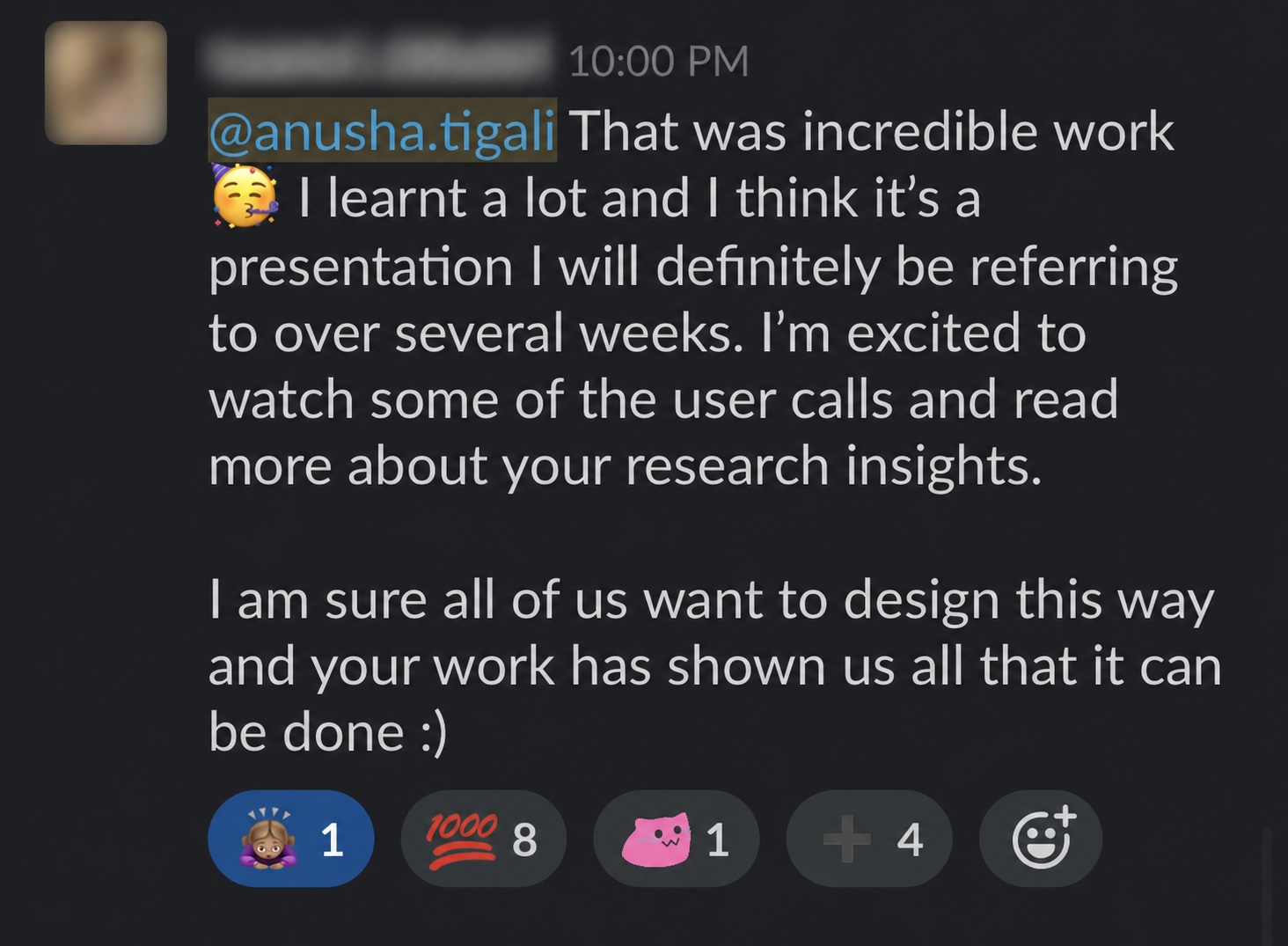
That became a reusable research playbook that other designers at Postman could use to conduct their own studies.
The project had started because I didn't know enough about the technical product I'd been asked to design.
It ended by giving other designers a structured way to learn what they didn't know too.
What I carried forward
Looking back, I'm proud of the product work we did on Mock Servers.
But the thing that stayed with me wasn't a particular screen.
It was learning how to design effectively when I wasn't the domain expert.
When I started, I thought my obvious weakness was that I didn't know enough about APIs. Over time, I realised that becoming the person who knew everything wasn't the goal.
I had engineers who understood the technology and users who understood their workflows better than any of us.
I had product analytics that could help me find the right users.
And I had research and design methods that could bring those perspectives together.
The important part was recognising where my understanding stopped and creating a reliable way to fill those gaps.
I now enjoy carrying this way of working into the increasingly technical products I've designed over the last three to five years.